Knowing how to measure AI success in a small business starts before the pilot launches — not after it stalls.
Many businesses have already tried AI.
Most have nothing measurable to show for it.
They picked a tool. Ran a pilot. Someone on the team used it for a few weeks. Early excitement faded. Work got busy. The pilot quietly stalled.
Now it sits somewhere between ‘we should revisit that’ and ‘maybe it just wasn’t right for us.’
That’s not an AI problem. That’s a definition problem.
Why Most AI Pilots Produce No Results
Research consistently shows that fewer than one in three businesses experimenting with AI capture measurable value. Some studies suggest the number is even lower.
That result makes sense when you look at how most pilots actually run.
The typical sequence: someone hears about a tool, the business agrees to try it, a small group starts using it, a few weeks pass, and then someone asks — usually too late — ‘is this actually working?’
You cannot judge whether a pilot worked if you never defined success before it began. Most teams start the experiment without a baseline, without a hypothesis, and without a threshold for success. When the trial ends, no one knows what the result means.
A pilot without a hypothesis is not a test.
It is an indefinite subscription.
Pilot Purgatory Is a Business Problem, Not a Tech Problem
There’s a pattern worth naming. Businesses that stay stuck in endless experimentation usually share a few things in common.
They started with the tool, not the problem. Someone got interested in what AI could do, found a product that seemed relevant, and worked backward to justify it. The tool came before the question.
They didn’t define the baseline. If you don’t know how long a task takes today, how many errors it produces, or what it costs in time and capacity, you have no way to measure whether anything improved.
They treated the pilot as the end, not the beginning. A pilot is a test. Tests need hypotheses, timelines, and pass-fail criteria. Without those, a pilot is just an indefinite subscription.
The result is pilot purgatory — a state where the business has spent money and time on AI, has nothing concrete to show for it, and isn’t sure whether to push forward or cut losses.
Three Conditions Required Before Any AI Pilot
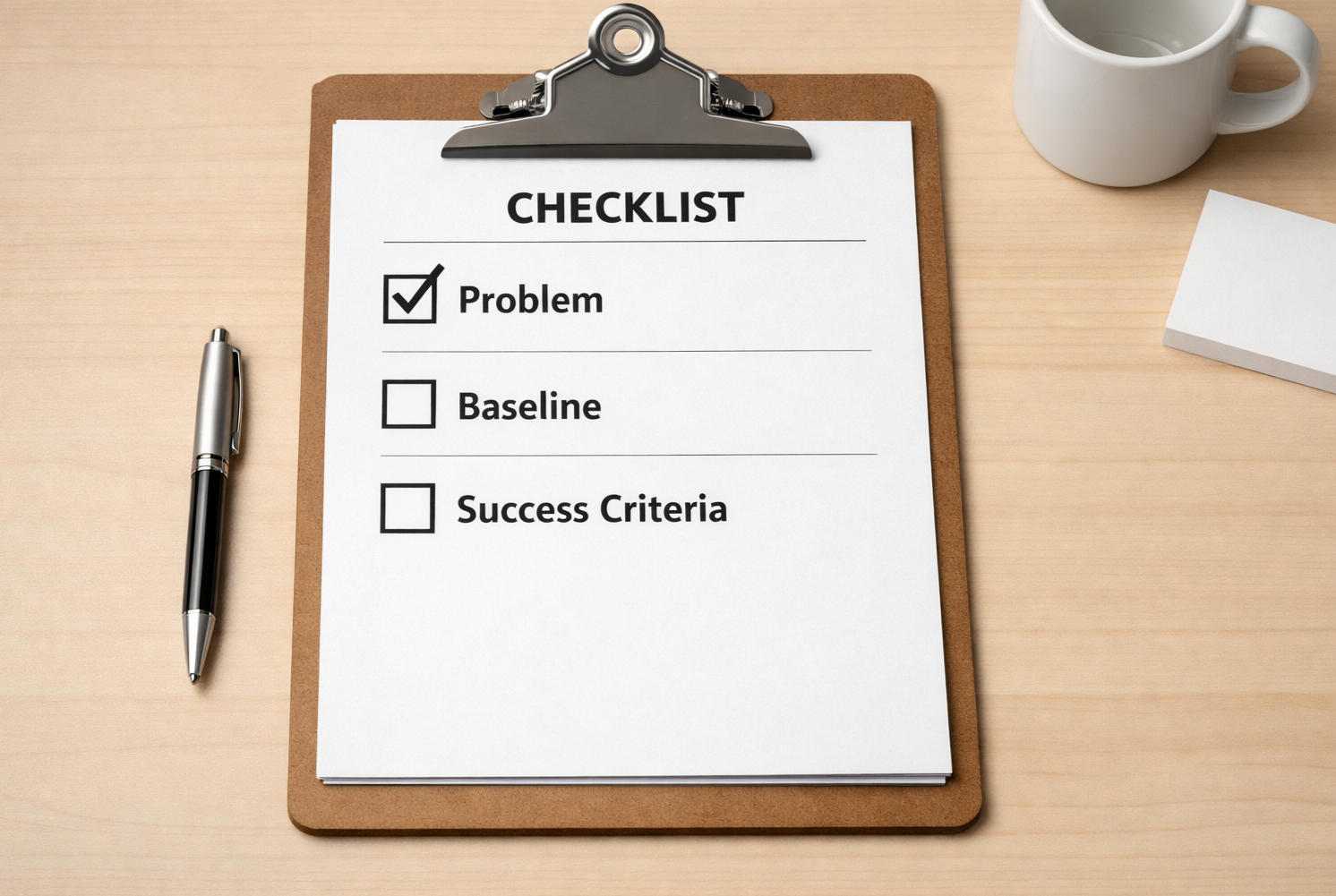
Knowing how to measure AI success in a small business is not complicated. What makes it hard is that the work happens before the pilot starts, not after.
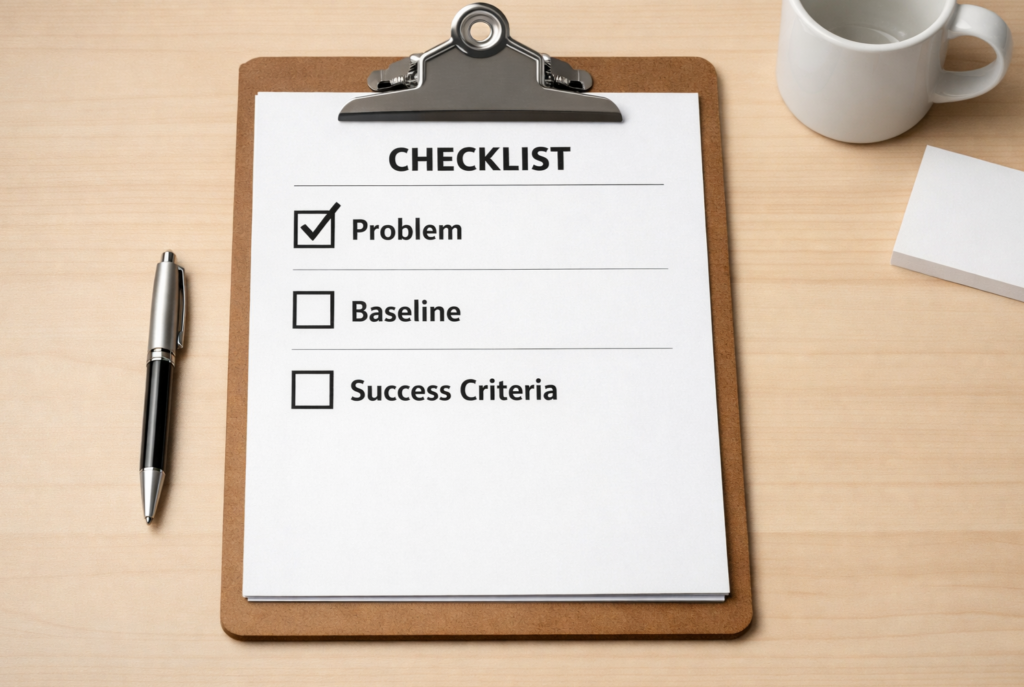
First, a specific problem. Not ‘we want to be more efficient’ — a concrete task, a named bottleneck, a process that is visibly costing you time or money right now.
Second, a current-state measurement. How long does that task take today? How often does it go wrong? What does it cost in hours, errors, or capacity? If you can’t answer this, you have no baseline.
Third, a definition of success. Not ‘it should be better’ — a specific outcome with a specific threshold. ‘We cut response time from 48 hours to 24 hours’ is measurable. ‘The team finds it helpful’ is not.
With those three things, a pilot becomes a test. You run it for a defined period, compare the result to the baseline, and make a call.
What Businesses That Capture Real Value Do Differently
The businesses that actually see results from AI tend to approach it the same way they’d approach any operational change.
They don’t start with AI. They start with the business. They look at what’s breaking, what’s slow, what’s consuming disproportionate effort. Then they ask whether AI is actually the right solution for that specific thing.
They pick one thing and go deep rather than running five pilots at once. They set a timeline, measure the baseline, define success, and hold the line on scope.
When the pilot ends, they review it against the criteria they set at the start. If it worked, they embed it. If it didn’t, they move on — without sunk cost reasoning and without restarting the pilot under a different name.
That discipline is not complicated. It’s just not how most businesses currently approach AI adoption.
If You’re in Purgatory Right Now
If your business has tried AI and has nothing concrete to show for it, the answer isn’t to try harder or find different tools. The answer is to go back upstream.
Before anything else, you need an honest picture of your business — where the real problems are, what the current state of your operations actually looks like, and whether AI is even the right intervention at this stage.
Most businesses skip this step because it feels slow. It’s the fastest path forward. When you know what you’re solving and why, everything else — tools, pilots, measurement — becomes straightforward.
Without it, you’re just running more experiments and hoping one of them sticks.
The TAKTOS Business Check is a structured diagnostic that identifies where the real problems are and whether AI is the right intervention at this stage. Learn more at taktos.ai/businesscheck.
Chuck Rayman is the founder of TAKTOS, an AI advisory and education firm for small businesses. TAKTOS helps owners determine where AI will deliver real value and where it will not. Visit taktos.ai.