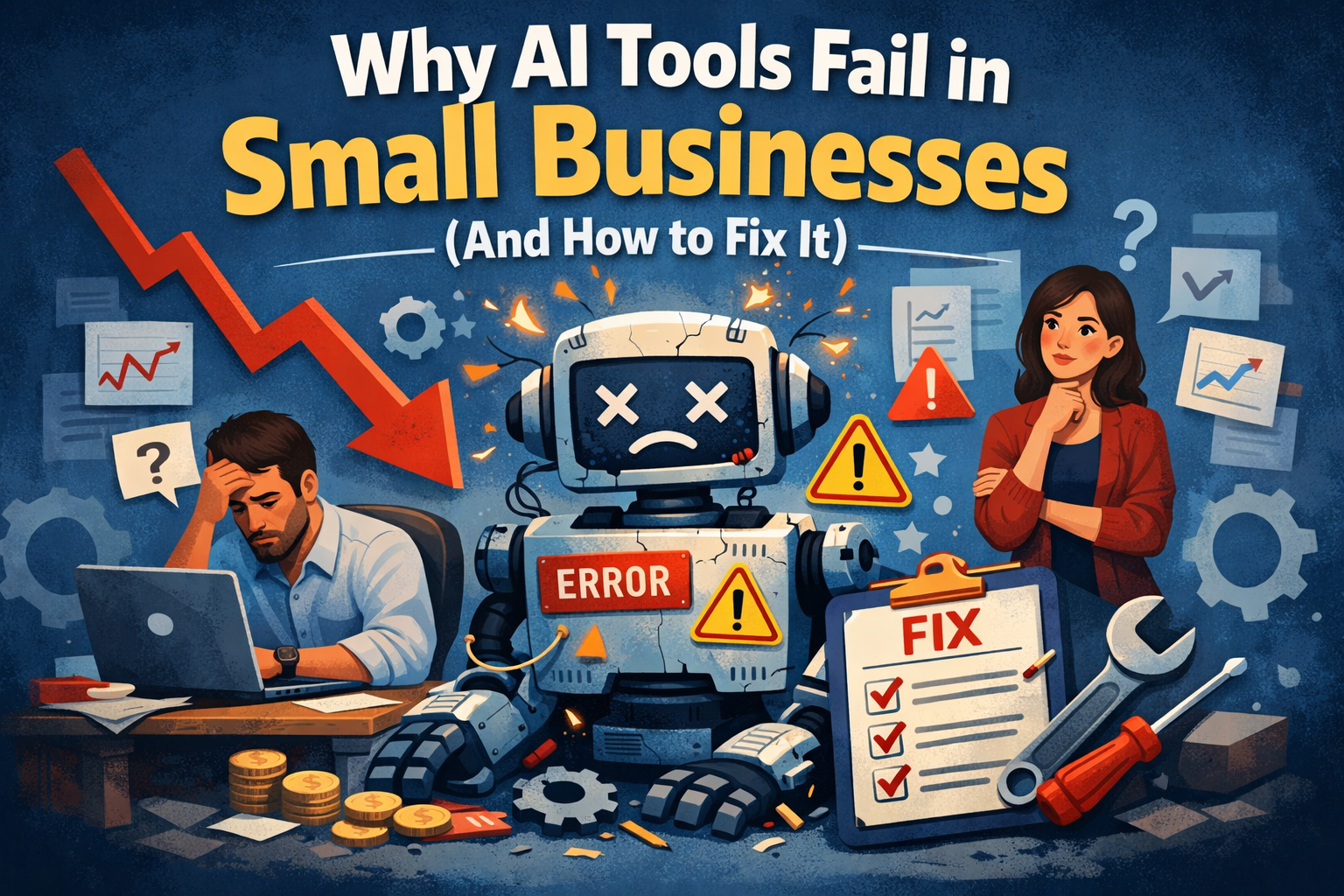
Small businesses waste money on AI. Not because the tools are weak. Because no decision came first.
I see the same pattern repeatedly. An owner buys an AI tool. The demo looks strong. The team shows interest. A few weeks pass. Then the tool sits unused.
The purchase felt like progress. In reality, it replaced a decision with motion.
What Usually Triggers the Spend
Most AI purchases in small businesses start the same way:
- A peer mentions a tool at a networking event.
- A vendor delivers a polished demo.
- A team member asks for help with their workload.
- An article promises efficiency gains.
Pressure builds. Something needs to change. The tool looks credible. The price seems reasonable. Money leaves the account.
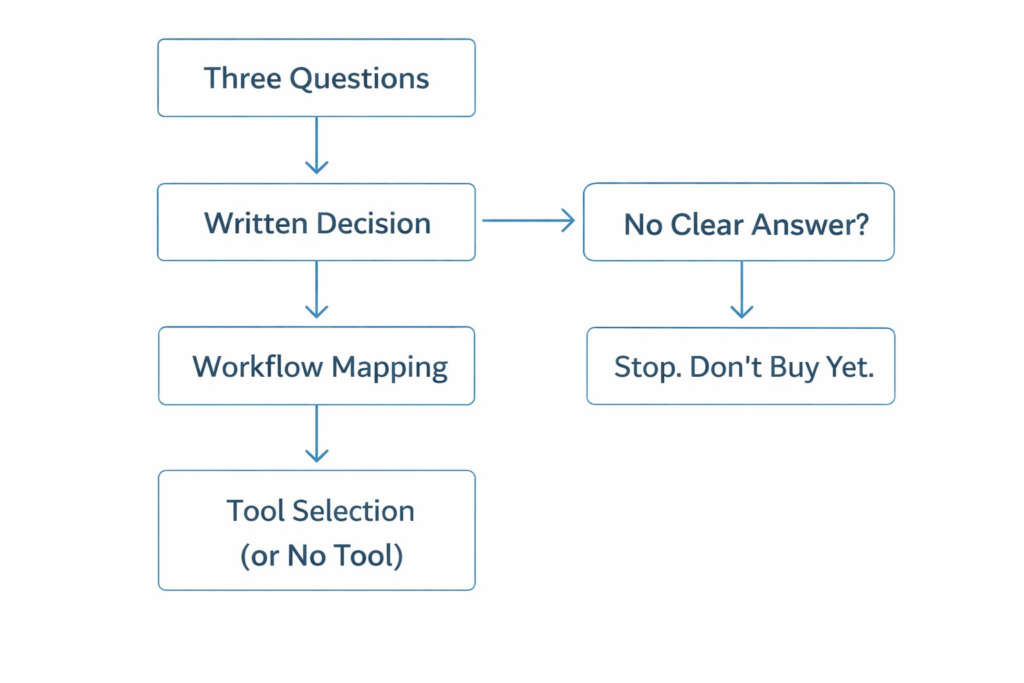
What never happens is the most important step. No one answers three basic questions:
- What specific work creates pain every single week?
- What outcome would count as improvement?
- What happens if nothing changes for the next six months?
When those answers are missing, everything downstream breaks.
The Pattern of Failed AI Adoption
The tool floats without purpose. No one owns it. No one champions it. Usage feels optional.
Experiments feel random. One person tries it for email. Another tests it for content. A third uses it once and forgets about it.
Results look inconsistent. Some tasks improve slightly. Others show no change. No one can point to measurable impact.
Confidence drops. The team questions whether they’re using it wrong. The owner wonders if they bought the wrong tool. Frustration replaces the initial optimism.
A scheduling tool sits unused because no one decided whether client booking speed or team calendar chaos was the actual problem.
Eventually the conclusion sounds familiar: AI didn’t work for us.
This pattern shows up across industries. A construction firm buys project management AI to track workflows, but the real problem is inconsistent communication between field teams and the office. A marketing agency adopts content generation tools, but the actual bottleneck is client approval delays, not writing speed. A medical practice invests in appointment reminders, but the core issue is last-minute cancellations driven by insurance confusion, not forgotten appointments.
In each case, the tool addressed a symptom, not the source. Without clarity on what problem mattered most, AI became another expense instead of a solution.
Why Most Advice Gets the Sequence Wrong
The standard guidance sounds reasonable:
Map your workflows. Identify automation opportunities. Pick the right tool.
That sequence assumes a decision already exists. In most businesses, it doesn’t.
Workflow mapping without priority turns into documentation for its own sake. Teams spend hours diagramming every process, creating detailed flowcharts, documenting handoffs. None of it answers which problem deserves attention now.
Automation without clarity turns into expensive guesswork. You automate what’s easy to automate, not what matters. The wrong tasks get optimized. The real friction points remain untouched.
Tool selection without a defined problem turns into vendor comparison instead of business improvement. You evaluate features, compare pricing, read reviews. But without knowing what you’re solving, every tool looks equally promising and equally uncertain.
This backward sequence wastes time and money. It creates the illusion of progress while postponing the only question that matters: what are we actually trying to fix?
The Real Question: Prioritization, Not Productivity
Decision first. Workflow second. Tool last, or no tool at all.
AI is not a productivity decision. AI is a prioritization decision.
Before you spend a dollar, one thing must exist in writing:
What work deserves improvement right now, and why.
Not what might improve someday. Not what AI is capable of. One specific friction that costs you time, money, or confidence every week.
This isn’t about creating a business case or building a proposal. It’s about clarity.
One paragraph. One problem. One reason it matters now.
If that decision is unclear, spending guarantees disappointment.
What This Looks Like in Practice
A manufacturing business writes: “Our quote process takes 3-5 days because pricing requires manual lookups across three systems. We’re losing deals to faster competitors. If nothing changes, we’ll miss Q1 targets.”
A professional services firm writes: “Client onboarding requires 14 back-and-forth emails to collect the same information. New clients wait a week to start. If nothing changes, we can’t scale past our current team size.”
A retail operation writes: “Inventory counts happen monthly and take 6 hours. We discover shortages after reordering. If nothing changes, we’ll keep overstocking slow items and running out of popular ones.”
Each statement names the specific work, explains the cost, and shows what’s at stake.
That clarity makes every decision after it easier. Workflow mapping focuses on the relevant process. Automation targets the actual bottleneck. Tool selection has a clear success criterion.
Compare this to the vague alternatives most businesses start with:
“We need to be more efficient.” (Efficient at what?) “Our team is overwhelmed.” (Which work is causing the overwhelm?) “AI could help us grow.” (Which constraint is preventing growth?)
Generic statements lead to generic solutions. Specific decisions lead to specific improvements.
What Success Actually Looks Like
When businesses get the sequence right, AI adoption looks different.
The manufacturing company above identified quote speed as the priority. They mapped only the pricing workflow—not every process. They found that 80% of quotes used standard configurations. They automated quote generation for those configurations only, leaving custom quotes manual. Implementation took two weeks. Quote turnaround dropped from 3-5 days to same-day for standard requests.
The professional services firm focused on onboarding friction. They didn’t automate everything—just the information collection step. They built a simple intake form that fed directly into their project management system. New clients received access within 24 hours instead of a week. The team saved 14 emails per client without changing anything else.
The retail operation tackled inventory visibility. They didn’t implement a full inventory management system. They added barcode scanning to their monthly count process and linked it to their reorder system. Counts dropped from 6 hours to 90 minutes. Reorder decisions became data-driven instead of guesswork.
In each case, the tool solved the specific problem because the problem was clear from the start.
| Without Clarity | With Clarity |
|---|---|
| Generic goal: “Be more efficient” | Specific problem: “Quote process takes 3-5 days” |
| Map every process | Map only the pricing workflow |
| Evaluate 10+ tools | Evaluate tools for one specific need |
| Team uncertain what to use | Team knows exactly what to automate |
| 3-6 months to see results | 2 weeks to implementation |
| Tool sits unused | Tool solves the stated problem |
The Practical Next Step
Do not buy anything yet.
Write one paragraph. Name one recurring problem. Explain why fixing it matters now.
If you cannot write it clearly, you are not ready to spend. If you can write it clearly, the next steps stop being confusing.
This exercise takes 10 minutes. It prevents months of wasted effort.
Start With a Simple Assessment
Before making any AI investment, download the AI Readiness Snapshot—a free, 9-page guide that helps you determine if you have the clarity needed to make AI work.
The Snapshot walks you through the questions most businesses skip:
- What specific work causes repeated friction?
- What would improvement actually look like?
- What happens if nothing changes?
No fluff. Just a structured framework to assess your readiness before you spend.
[Download the AI Readiness Snapshot →]
Make the decision first. Everything else follows.
Chuck Rayman
Founder, TAKTOS
Simplify AI. Amplify Growth.