Most failed AI implementations were not careless. The owner saw a real problem. They mapped it. They chose a tool. They trained the team. Three months later, the problem had not moved.
The tool gets blamed. The vendor gets blamed. Sometimes AI itself gets blamed.
The sequence was the problem. Specifically, one part of the sequence most owners skip without realizing it — checking whether they are fixing the problem at the right layer.
Visible problems and root problems are not in the same place
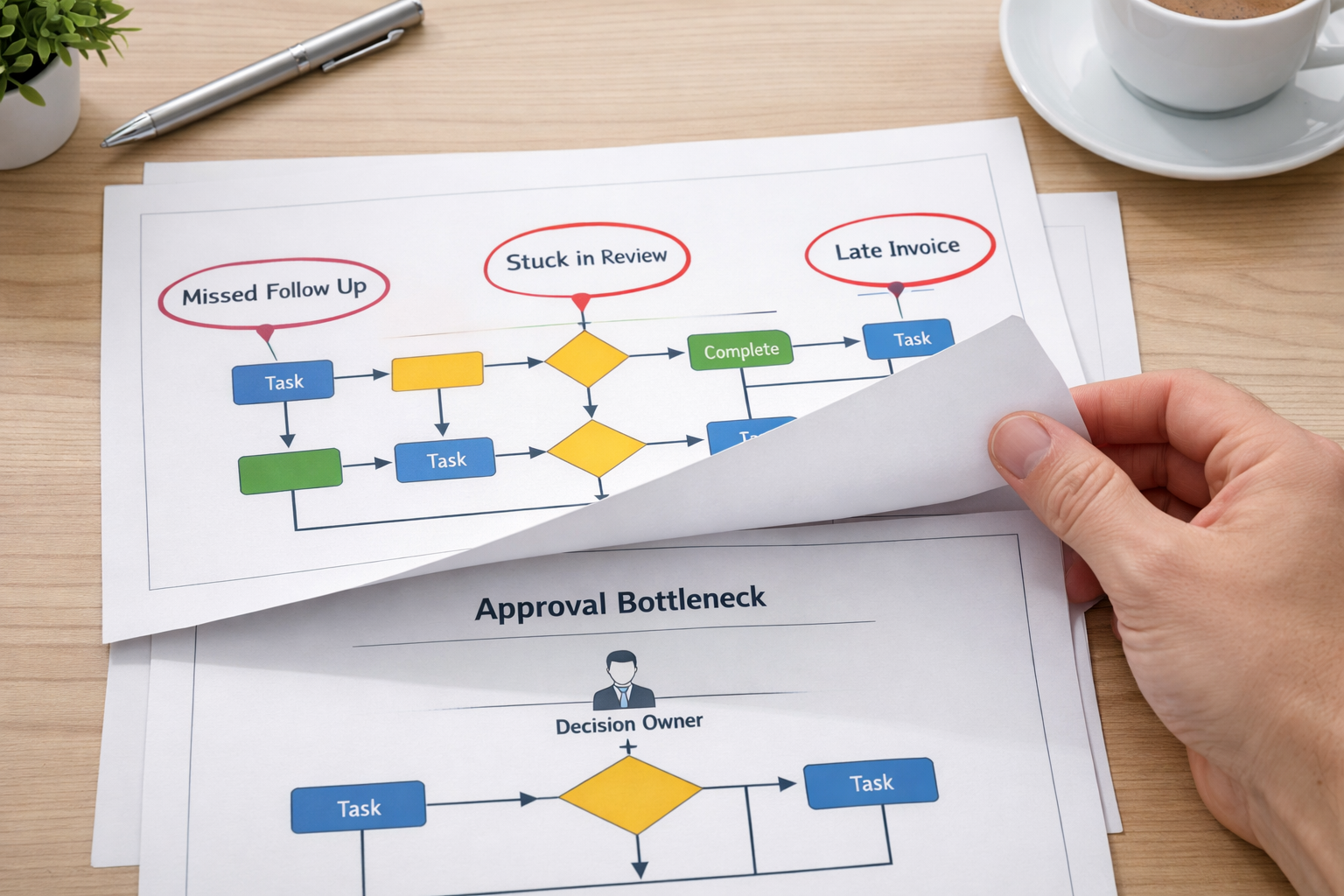
What you see is where the pain surfaces. A late invoice. A missed follow-up. A scheduling breakdown that costs you half a day every week.
Those are real. They are worth fixing. But pain surfaces downstream. The cause lives upstream.
You can address the visible problem accurately and still not touch the root. Not because you were wrong about what you saw — but because the visible layer and the broken layer are different things.
A follow-up process that keeps failing is not always a follow-up problem. It may be a sign-off problem. A handoff problem. A decision that only one person can make, sitting quietly one step earlier in the chain, creating a backup that looks like something else by the time you notice it.
AI executes what is described. It does not expose what is informal. If the real problem is undescribed — informal, dependent on one person, held together by a workaround that became a habit — no tool resolves it. The tool runs cleanly on top of a broken foundation and the results stay the same.
The layer question
Before you introduce any tool, ask one question about the problem you have identified:
If someone other than you tried to run this process correctly, what would stop them?
If the answer is nothing — the information is accessible, the decision criteria are clear, the steps are documented — you are probably at the right layer. A tool can help.
If the answer involves a specific person, an informal system, or knowledge that lives in someone’s head and nowhere else, you are one layer above the real problem.
The work at that point is not to find a better tool. It is to go one level deeper and describe what is actually holding the process together — workarounds included. That description is what makes automation possible. Not the other way around.
What order actually means
I use the word order deliberately. Not organization. Not efficiency. Order.
Order means the work can move without you. The decision has been written down. Someone new could follow the process and arrive at the right result.
When order exists, AI extends it. When order is missing, AI covers for it temporarily — and the underlying problem resurfaces somewhere else, usually in a way that is harder to trace back.
This is why two businesses can buy the same tool, follow the same setup process, and get completely different results. The tool did not change. The foundation did.
The move most owners miss
Diagnosing the visible problem is not enough. Ask whether you are fixing it at the right layer.
Go one level deeper. Fix the dependency that is not written down.
Then bring in the tool.
The pain point may have been right. The layer was wrong. And no tool closes that gap.