
Knowing what to do before buying AI tools is the decision that separated one cleaning company’s results from every business that bought the same tools and got nothing.
Most people read the Fortune story about Rick Chorney and focus on the tools.
That is the wrong place to look.
Chorney runs a janitorial company in Abbotsford, British Columbia. He started subcontracting jobs, working 19-hour days, pulling in roughly $14 an hour. Last year his company did just under a million dollars in revenue. Fortune verified the numbers. The growth is real.
The coverage centers on the AI stack he built — an AI receptionist, automated intake forms, an inbox sorter, Claude for client documents. Those tools matter. But they are not what produced the result.
What produced the result happened before he set up anything.
He Stopped Before He Searched
Chorney did not start by researching tools. He started by hitting a wall.
He described the moment plainly: he was done. Nineteen-hour days, seven days a week, handling every quote, every call, every email himself. The business was running and it was breaking him.
That day, instead of opening another quote, he spent four hours mapping what he was doing and asking where AI could take it off his hands. He identified specific tasks — customer intake, quote acknowledgment, phone handling. Then he automated them.
He did not start with tools. He started with a clear picture of what work he was doing that did not require him personally.
The Tool-First Mistake
Most decision-makers read a story like this and move in the wrong direction. They focus on the stack and start evaluating options.
That sequence produces a different outcome.
When a tool gets purchased before the workflow is mapped, it gets layered on top of whatever was already running. The intake form gets automated, but the manual follow-up stays. The AI receptionist handles calls, but the owner still checks the voicemail. The inbox sorter runs, but the habit of opening every email continues.
The tools run. The time does not come back. At 60 days, the question — did this work? — has no answer.
This is the tool-first mistake. Chorney avoided it by accident. Most businesses make it on purpose.
The Sequence He Used Without Naming It
Chorney did not use a formal framework. He described the process the way someone describes common sense. But the sequence is specific.
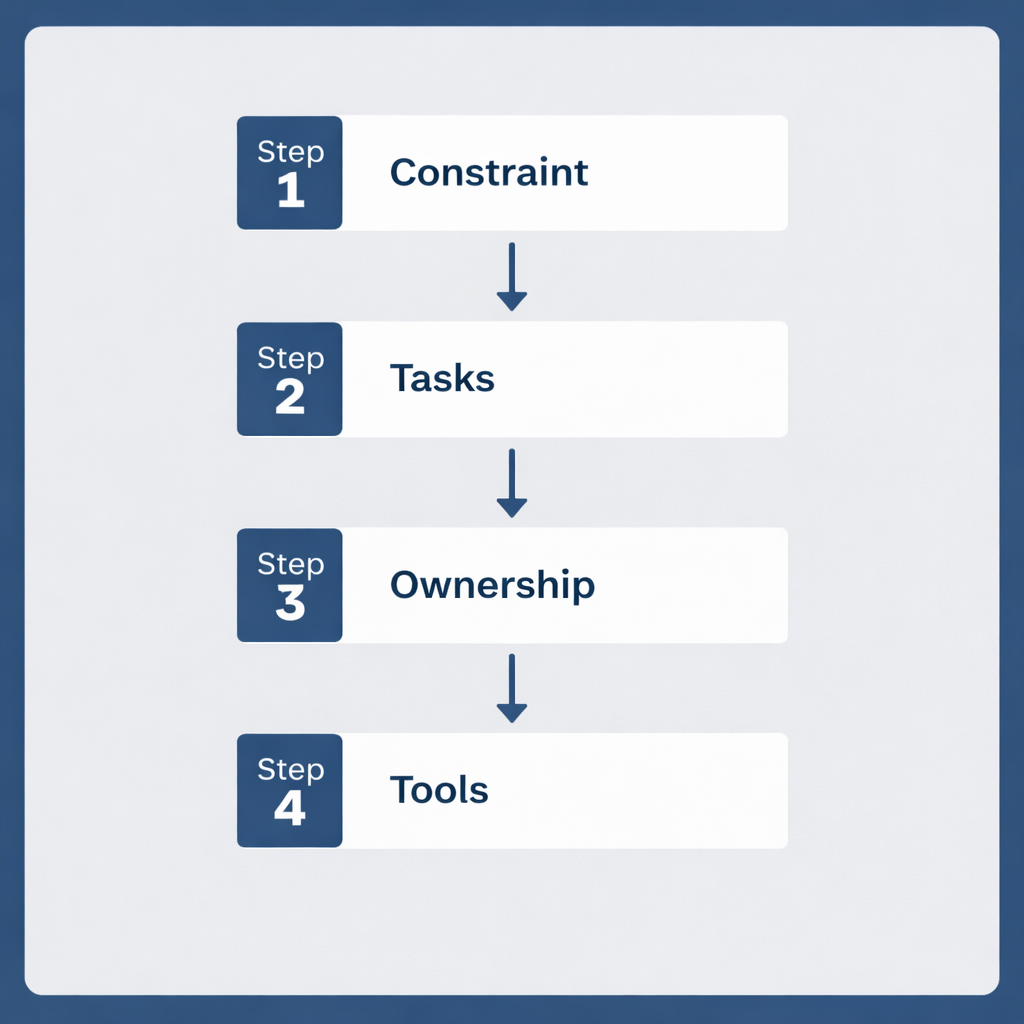
He identified the constraint. He was the bottleneck on every task at every hour. That was the diagnosis.
He mapped what he was doing. Customer intake, quote acknowledgment, inbound calls. Specific tasks, not categories of work.
He asked whether those tasks required him. They did not.
Then he selected the tools.
That order is what to do before buying AI tools. Tool selection came last, after the tasks were defined and the ownership question was answered.
What the Revenue Number Is Not Telling You
The growth from $242,000 to just under $1 million gets the headline. It will lead people to conclude the tools drove it.
The tools worked because the workflow was clear before they were introduced. Chorney knew exactly what each tool was replacing and what he would do with the time it returned.
A business that introduces the same tools without that clarity gets a different result. The receptionist fields calls that still get re-reviewed. The intake form routes inquiries that still get manually processed. The inbox sorter runs alongside an owner who still reads every email.
Same tools. Different outcome. The difference is the work that happened before anything was purchased.
The Right Question After Reading This Story
The question Chorney’s story raises is not which tools he used.
It is: what work are you doing right now that does not require you specifically?
Most people in a business have never written that down. They know roughly what they spend time on, but they have not mapped it task by task or asked plainly whether any of it could run without them in the loop.
That mapping is the starting point. It is what Chorney did in four hours on the day he decided he was done.
If you do it, the tool question becomes easy. The tasks are defined. The ownership is clear. The match to tools is obvious.
If you skip it, you have Chorney’s tools and somebody else’s result.
The Business Check exists for this exact situation. It is a structured diagnostic that identifies where you are the bottleneck, which tasks do not require you, and what order to address them. Learn more at taktos.ai/businesscheck.
Chuck Rayman is the founder of TAKTOS, an AI advisory and education firm for small businesses. TAKTOS helps owners determine where AI will deliver real value and where it will not. Visit taktos.ai.